

Frequently asked questions
Will I still have an electricity bill?
Yes, but following the successful installation and commissioning of your system, we will ensure your electricity bill reflects the significant savings you will start to enjoy!
The annual electricity consumption of an average house in the UK is taken as 4,700kWh (source: http://webarchive.nationalarchives.gov.uk/+/http://www.berr.gov.uk/files/file43304.pdf)
The electricity consumption will differ from household to household but on average a well designed PV system can provide up to 75% of annual consumption.
Do I need planning permission?
Solar PV installations are covered under the Permitted Development Rights so planning permission is not normally required. However, planning permission may be required if your property is listed or in an Area of Outstanding Natural Beauty. We always recommend that you contact your local building control officer in order to make them aware of your intentions.
How long will my Solar PV installation last?
The system is designed to last a minimum of 25 years. The panels have a guaranteed output for 25 years, inverters typically have a manufacturer’s guarantee for 5 years and all of our work is guaranteed for 5 years.
Do I need a south facing roof?
No - for every kWp installed on a south facing roof roughly 800kWh will be generated annually. This only reduces by 20-25% for an East or West facing roof which still provides a significant return on investment.
Will I have to clean the Solar PV panels?
The panels are similar to a skylight in that they are generally self-cleaning. We can provide a full maintenance package which includes annual cleaning and electrical testing.
What does your survey involve and how long does it take?
Our survey should take no more than 2 hours and involves checking your electrical system, loft and roof structure as well as making dimensioned drawings of your roof.
What if I sell my house?
Houses with PV installed are becoming increasingly popular so having a system installed will make your house stand out and could aid your sale. The Energy Saving Trust has a report on how renewable energy affects house prices here: http://www.energysavingtrust.org.uk/Publication-Download/?p=4&pid=1368
What happens during a power cut?
A grid connected system instantly switches off when a power cut occurs. Disconnection during a power cut is necessary to ensure power quality and protect workers who may be repairing the fault. The system will automatically re-start once the power cut ends.
How is the solar electricity used?
The output from a grid connected solar panel installation is fed directly into your Consumer Unit (fuse board). The inverter ensures your solar generated electricity exactly matches the voltage and frequency of electricity from the grid. Any electricity not being used in your building is automatically sold to your energy supplier.
How will I benefit from Solar PV?
There are very compelling economic and ethical reasons to install a solar energy system. Solar power creates no pollution or waste products; it's a completely clean source of energy.
There's also a strong financial benefit to installing solar panels – for each unit of electricity you produce, you will be paid according to the national Feed-In-Tariff (FIT). You'll also be paid for any surplus electricity you feed back into the grid. Over time this can amount to a substantial income.
What's the Feed-in-Tariff (FIT)?
The Feed-In-Tariff exists to encourage householders and business owners to develop their own clean electricity supply. You will be paid around three times the usual price per unit for the electricity you produce, plus a further rate for surplus energy which is fed back into the grid. Your renewable energy income is tax-free, and will be linked to the Retail Price Index, to protect you from inflation. FITs are underwritten by law and your income will be protected for a minimum of 25 years.
What is the payback for a solar PV installation?
A system should pay for itself around 3-4 times over a 25 year period. This is based on an annual fuel inflation of 6%, however the return could be much greater as Ernst and Young and the government’s new Feed-In-Tariff proposals estimate that fuel inflation may rise to 12.9% annually meaning a system would pay for itself approximately 6 times over a 25 year period.
Are there any deadlines?
The Feed-In-Tariff rates are due to be reduced for any installations after 31 March 2012. As the Feed-In-Tariff rate is guaranteed for 25 years from the date of install it makes sense to have a system installed before this deadline in order to benefit from the highest possible rate of return.
How does solar electricity work?
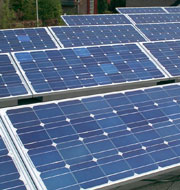
Photovoltaic systems use cells, consisting of one or two layers of semi-conducting material, to convert solar radiation into electricity. The semi-conducting material is generally silicon.
When light strikes the photovoltaic cell, the energy of the light is transferred to an electron. Photovoltaics are made with two different types of impurities added to the bulk material. These impurities force the negatively charged electrons to move to one surface, where they are collected by electrical contacts. When wires are connected to these contacts, the electrons can then flow around an external circuit, to the opposite surface of the photovoltaic material. In doing so they give up the energy originally gained from light as useful electrical energy.